
Every creative struggle comes from one of three places.
Talent isn’t enough to make it work (and you know it).
You feel it deeply: somehow, you have what it takes.
You have taste. You can tell what’s good and what isn’t. You’ve built enough skill to know you’re not starting from zero.
And still, your creative life hasn’t taken off the way you thought it would by now.
When that gap persists, most creatives turn on themselves. More discipline. More output. More pressure.
But this is rarely where the struggle actually lives.
Talent alone doesn’t create your desired outcomes.
If it did, the most talented people would always be the most stable, visible, and fulfilled.
We both know that isn’t true.
Talent is what you have.
Creativity is what happens when talent meets conditions.
Most creative frustration comes from trying to solve a three-dimensional problem with a one-dimensional solution.
We focus on improving ourselves: our skills, our confidence, our mindset, while ignoring the other forces shaping our creative reality.
The Creative Friction Model
Creativity doesn’t live in one place.
It operates as a system: shaped by what’s happening inside you, around you, and over time. Here’s the model I recently created to make sense of that:
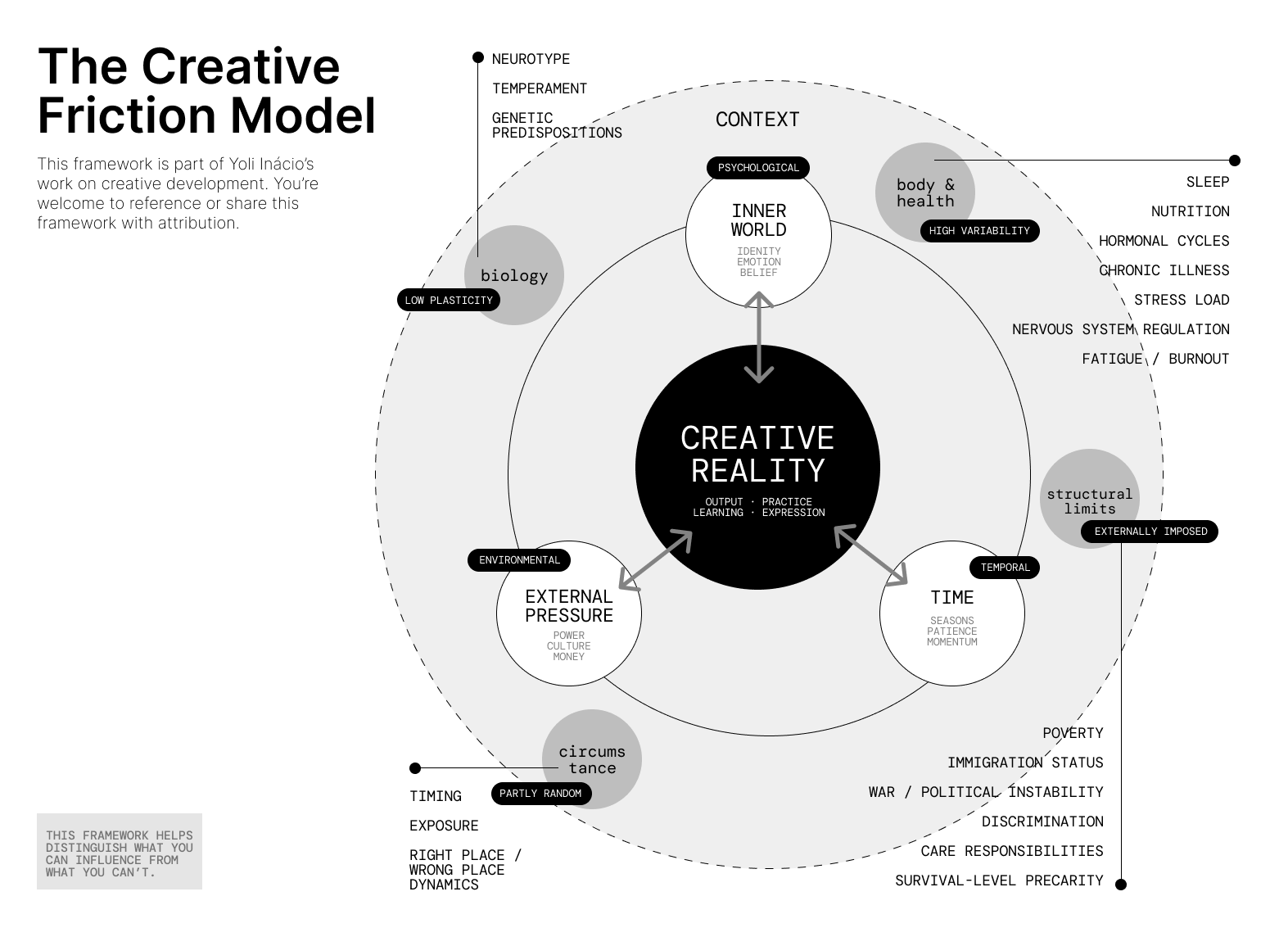
You can look at almost any creative struggle through this lens.
Inner world
This is where self-trust lives (and where it erodes).
It includes:
– Identity → who you think you are (and aren’t allowed to be)
– Emotion → fear, desire, shame, excitement
– Belief → what you assume is possible or “for people like you”
It shows up as:
“I don’t feel ready.”
“I lost my confidence.”
“Maybe I’m not actually creative.”
External pressure
Platforms, trends, algorithms, and money create invisible rules that are often mistaken for personal failure.
External pressure also includes who you’re surrounded by: mentors, peers, collaborators, or the absence of them.
It includes:
– Culture → trends, algorithms, taste, comparison
– Systems → platforms, education, productivity norms
– Money → survival pressure, pricing, stability
It shows up as:
“I need to be consistent.”
“Everyone else is doing it better.”
“This won’t pay the bills.”
Time
The most ignored layer.
Creative work isn’t linear. It moves in seasons: growth, rest, transition, integration.
Time includes:
– Seasons → when to expand, when to consolidate
– Patience → tolerating the in-between
– Momentum → slow accumulation, not overnight results
It shows up as:
“Nothing is happening.”
“I’ve been doing this for years.”
“I’m late to the game.”
Context: All of this unfolds within conditions we don’t fully control, like energy, health, and circumstance, but the core dynamics stay the same.
Reframe
This model doesn’t promise outcomes.
It doesn’t tell you what to do.
It helps you understand the conditions around it, so your effort stops being wasted in the wrong place.
So if you feel like you’re “not doing enough,” try asking:
– Is this the wrong season?
– Am I responding to pressure that was never meant to be internalized?
– Am I forcing flow before a basic foundation is ready?
Instead of asking “What’s wrong with me?”
try asking something more useful:
Which layer is asking for attention right now?
Your inner world?
The external system you’re operating in?
Or time itself?
Talent isn’t the problem. It never was.
Understanding the conditions around it changes everything.
Not by pushing harder, but by working with reality as it is.
To celebrate recently hitting 10k on Instagram, I wanted to give back to those who have been following me on this journey of understanding and using creativity in our favour. So, if you want a checklist to self-assess those creative frictions in your life as a starting point on where to focus your energy and act on it (totally for free), you can get it here.
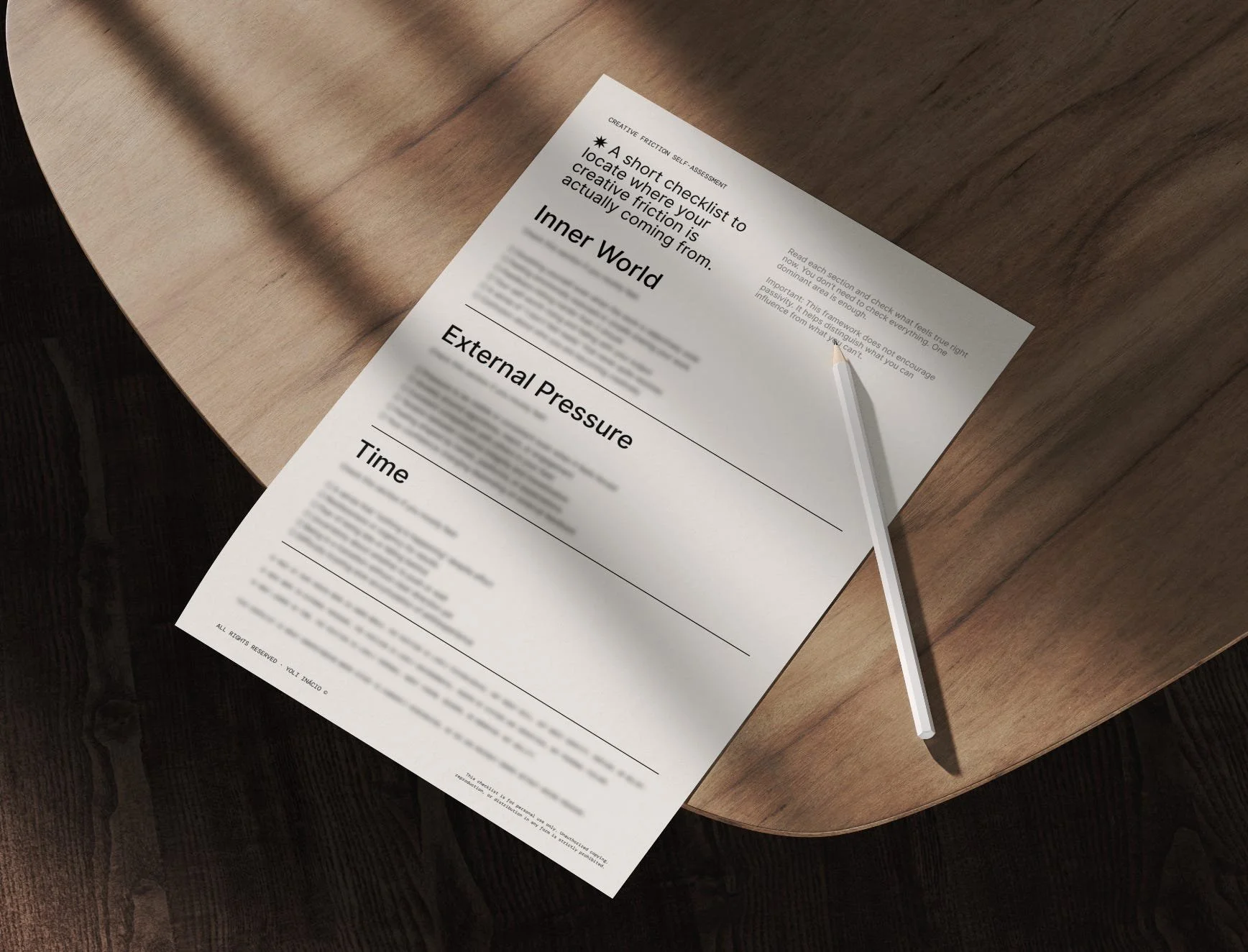
I would love to hear feedback on it, just hit reply in this email.
Thank you for reading.
Until next time,
Yoli